

Perron Family Y- chromosome
DNA Project Update
By Ronald F. Eustice (55), Project Coordinator
Family histories can be complicated. If we think we know everything about our family, we need to think again. Many have a hard time going beyond the great grandparent level and are surprised to learn they have hundreds or even thousands of cousins. Y-chromosome DNA testing can help confirm accuracy of traditional research, establish familial connections and answer questions about your family history before the history is lost.
The Perron Y-chromosome DNA Project is growing and now has thirteen participants from Quebec, Manitoba, Massachusetts and Minnesota. The project includes a small number of samples from the three branches. We do have a high percentage of close and identical matches between individuals within each group. Now we need more participants to obtain a statistically reliable sample.
Inheriting the Y-chromosome
Everyone has 46 chromosomes grouped into 23 pairs. One pair is the sex chromosome which among other things determines gender. All women have a pair of X chromosomes (one from each parent) and men have an X chromosome which they receive from their mother and a Y chromosome which passes essentially unchanged from father to son. Because the Y chromosome changes relatively slowly over time and is only passed along the direct male line, it is very useful to trace paternal lineage.
Males usually carry an exact copy of the Y-chromosome that their father carried. Male descendants from two brothers who lived 500 years ago will usually carry the same Y-chromosome. Mutations can occur and the profile can change over time but the overall change is typically low within a family unless a very broad time range is considered. Cases of non-paternity can also affect the line and are observed to range from 10-20%.
So, why use the Y-chromosome?
Because the Y-chromosome does not change frequently, many distant cousins will have very similar or identical Y-chromosome profiles. This makes it an interesting and powerful tool for the genetic genealogist. It could be the catalyst for genealogists to find or confirm the information they seek.
Haplogroup Analysis
In order to understand what a haplogroup is, we need a few definitions. The first would be for the term marker. A genetic marker is synonymous with locus, polymorphism, genotype, and allele but they all refer to a specific location in your genetic code that has been found by researchers to exhibit different variable DNA types in the population.
For example, 30% of the population may have the DNA type "12" and 2% may have an "11".
When a group of genetic markers are tested on the same chromosome it is termed a haplotype. If we test 16 markers on the Y-chromosome, the haplotype might be "10, 11, 15, 22, 17, 11, 14, 17, 22.2, 9, 15, 13, 12, 16, 12, 18". This profile will be almost always the same as the subject’s father and his father before him. Once we have determined the subject's haplotype a statistical comparison can be made to haplotypes resulting from tests on many people to determine the haplogroup to which the subject most likely belongs.
Location is Everything
At first glance, the numbers that make up test results may not mean much. It is a bit like looking at the intricate pattern of a snowflake under a microscope or the whorls on the pad of your finger tip. To determine genetic profiles, we look at several scientifically established DNA "locations" in a Y-chromosome profile. The word haplotype is the scientific term for this kind of genetic profile. Markers on the Y-chromosome from participant DNA samples are analyzed and compared with other Perron participant results to locate persons that are closely related and identify the most recent common ancestor. DNA haplotypes results are useful only for our database to match you with possible genetic cousins and tell you about our ancient ancestors. Test results don’t tell you (or us) anything about hair color or other personal characteristics. The way we use DNA is very different from what you may have seen on TV or heard about in the past. Additionally, traditional genealogy research has led to identify potential living relatives---particularly those who share a common surname or descend from someone with the same surname. We can then confirm these individuals as relatives by encouraging them to take a Y-chromosome test as well.
Haplogroups of the World
Researchers have tested thousands of people from around the world at the same markers that we test to determine their haplotypes. The patterns that are exhibited can be grouped together and information about the origins of that group of individuals can be surmised from the consistency of the pattern. We will need greater numbers of participants to confirm ancient origins of the Perron families based on haplogroups.
We’ll tell you more in a future issue.
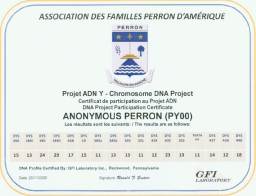
Certificate model
______
Other texts